News

January 16, 2018 — Medtronic plc announced the company’s Neurovascular business unit received U.S. Food and Drug Administration (FDA) clearance of the Riptide Aspiration System, adding a tool to its acute ischemic stroke (AIS) product portfolio.

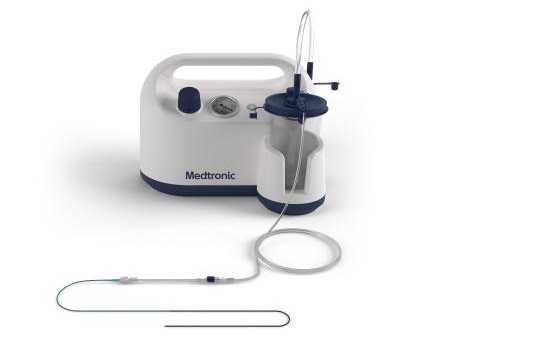
The Riptide Aspiration System is designed to retrieve thrombus (blood clot) through the Arc Catheter and restore blood flow in patients experiencing blockage of an artery in the brain, known as an ischemic stroke. The procedure involves inserting a catheter through an incision in the leg and up to the blocked artery, allowing the physician to remove the blood clot.

The Riptide Aspiration System is intended for use in the revascularization of patients with acute ischemic stroke secondary to intracranial large vessel occlusive disease (within the internal carotid, middle cerebral – M1 and M2 segments, basilar and vertebral arteries) within eight hours of symptom onset. Patients who are ineligible for intravenous tissue plasminogen activator (IV t-PA) or who fail IV t-PA therapy are candidates for treatment.

“While I primarily use the Solitaire Revascularization Device to treat patients with acute ischemic stroke, I utilize a direct aspiration approach as my first-line treatment strategy in select circumstances such as basilar artery thromboembolism and in select anterior circulation cases,” said Daniel Sahlein, M.D., interventional neuroradiologist, Goodman Campbell Brain and Spine, assistant professor of clinical neurology in the Department of Neurological Surgery, Indianapolis University-Purdue University Indianapolis. “The Riptide Aspiration System will provide me with another proven Medtronic product to utilize when treating stroke patients.”

The Riptide Aspiration System includes the Arc Catheter, Riptide Aspiration Tubing, Riptide Aspiration Pump and Riptide Collection Canister with intermediate tubing. The Riptide Aspiration System is a foundational platform for future aspiration catheters, currently in development.

According to the American Heart Association/American Stroke Association (AHA/ASA), stroke is the fifth leading cause of death in the United States, and a leading cause of disability. In June 2015, the AHA/ASA published new stroke treatment guidelines that recommended the use of stent retriever technology – such as the Solitaire stent retriever device – in conjunction with IV rtPA/alteplase as a first-line treatment for eligible patients.

Internet

ELP allows FDA staff to conduct site visits with research, clinical, manufacturing and healthcare facilities to observe how medical devices are designed, developed and utilized

July 17, 2019 — The U.S. Food and Drug Administration (FDA) Center for Devices and Radiological Health (CDRH) announced the 2020 Experiential Learning Program site visit proposal solicitation period. The 2020 Fall ELP submission period is open from Monday July 8, 2019 – Thursday, August 8, 2019, at 12 p.m. EST. The ELP is intended to provide a formal training mechanism for regulatory review staff to visit research, clinical, manufacturing and healthcare facilities to observe how medical devices are designed, developed and utilized.

The program has expanded to provide FDA staff with opportunities to better understand policies, laboratory practices, patient input and quality system management. The ELP is a collaborative effort to enhance communication and facilitation of the medical device review process. CDRH said it is committed to understanding current industry practices, innovative technologies, regulatory impacts and needs, and how patient perspective and quality systems management advance the development and evaluation of innovative devices.

CDRH is inviting medical device companies, academia and healthcare facilities to participate in this formal training program. Details of the program can be found on the ELP website, which provides the background, current training needs and proposal submission process. The training needs will be updated twice a year, in February and July, with a solicitation period for stakeholders to submit training proposals.

Internet

“The Indian-made SMT SuperFlex stent. SMT has been developing stents and other interventional products designed to be a more affordable, home-grown option for the growing Indian market.”

The rise cardiovascular disease has been instrumental in fueling the coronary stent market share in the past few years. Sedentary lifestyle and a drastic change in dietary patterns have led to a surge in heart-related disorders across the globe. The demand for coronary stents has been increasing, which has encouraged medical devices and equipment manufacturers to focus on creating affordable and sustainable products to garner a competitive edge over rivals. The growing utilization of drug-eluting stents (DES) and biodegradable polymer-coated coronary stents is expected to propel the growth potential of coronary stents in the years ahead. This is according to a new report by Global Market Insights Inc., a global market research and consulting service provider.

Overview Major Advancements in Drug-eluting Stents

One of the most prominent challenges faced by clinical physicians and cardiologists during the percutaneous coronary intervention (PCI) is the prevalence of complex vasculatures or lesions in small vessels of patients suffering from coronary artery ailment. Significantly, about 65 percent of smaller vessels are situated in difficult-to-reach areas of the heart, which invariably makes it difficult to treat lesions.

Considering these challenges, the Ireland-based coronary stents market leader Medtronic has recently introduced the Resolute Onyx 2.0 mm Drug-Eluting Stent. The FDA-approved, high-grade stent is the smallest sized drug eluting stent currently available on the market and is specifically designed for small vessels, which are often untreatable with bigger stents during percutaneous coronary intervention (PCI) procedures. Moreover, the new stent could further assist interventional cardiologists in treating coronary artery diseases more effectively.

In order to overcome the limitations of bare metal stents, numerous companies in the coronary stent industry have been focusing on developing DES coated with biodegradable polymers. For instance, the India-headquartered medical devices company SMT has recently unveiled an advanced DES system called the Supralimus Grace, which has been equipped with a biodegradable polymer coating and features fourth generation design. It has also been further improvised for low deflation profile to retrieve the delivery system after dilation of the stent.

Companies have been proactive in developing DES coated with biodegradable polymers to enhance clinical outcomes. Consequentially, this has assisted coronary stents market players to focus on research and tap into new business opportunities being opened up across various geographies.

One issue holding back further market expansion of coronary stents in the developing world is that the majority of stent procedures are paid out of pocket. The exorbitant prices of advanced coronary stents has always been a cause of concern in these countries.

Growing prevalence of coronary artery disease, which is one of the major causes of mortality, along with higher prices of stents have been crucial factors that have compelled various regulatory agencies to boost the availability of affordable coronary stents across their respective countries. The National Pharmaceutical Pricing Authority of India (NPPA), for instance, reduced the prices of DES in February 2018. The goal of pricing control is to increase demand for coronary stents. Growing per-capita income and healthcare expenditure could further contribute toward the growth prospects for the Indian coronary stents market. Global Market Insights reports the Indian coronary stent industry is projected to expand at a CAGR of 11.9 percent over the estimated time by 2024.

The swift-paced technological innovations with regards to the development of high-grade coronary stents and concerted efforts by various medical devices manufacturers to create stents that are user-friendly could fuel market expansion. In addition to this, a favorable regulatory framework across emerging nations would benefit the profile of the  coronary stentmarket, which is cexpected to exceed $11.9 billion by the year 2024.

Internet

Theme Settings